Did You Know
?
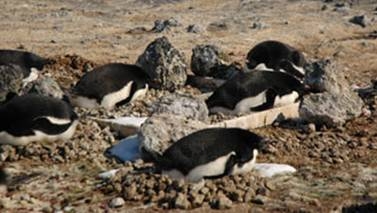
1. Adelie
Penguins eat the most readily available, high-energy food they can find
and easily swallow.
2. The diet of Adelie Penguins changes when whales are present because the
whales eat the same thing but eat much more than do the penguins.
3. Adelie Penguin diet differs depending on the habitat where they are foraging.
For example they eat different fish in shallow water comapred to deep water.
One
way to determine what kind of fish penguins eat, is to put a tray where
they will build their nests. Over the season, they will poop into the tray.
At the end, we wash what is in the tray to find the otoliths. Kind of like
panning for gold. Otoliths are a part of fish that take the longest to digest.
To
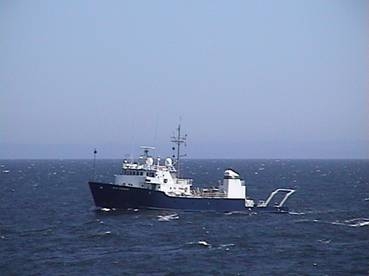
understand where the penguins’ prey is located requires a very expensive
but exciting study. We need a ship that can move in the pack ice, and one
that can pull nets through the water or sense the occurrence of fish or crustaceans
by sound waves. The trawling (catching fish with a net) needs to occur where
we know that the penguins are feeding (see Satellite
tag section). The large white structure at the back end of this
vessel is a frame for pulling a large net through the water.
Diet
Knowing
what a bird eats helps us to understand how they live and where they have
to go to find food. This is important because to protect a species population
we need to conserve and protect its food source.
We
know what a penguin eats, at least during the summer, from watching what
passes from a parent to its chick, or what the parent regurgitates onto
the ground. At other times of the year, we have to capture penguins and
cause them to regurgitate into a bucket. During most of the year the Adélie’s
diet is composed mainly of small fish. When fish are not easily available
or require extra effort to find, they eat krill and squid.
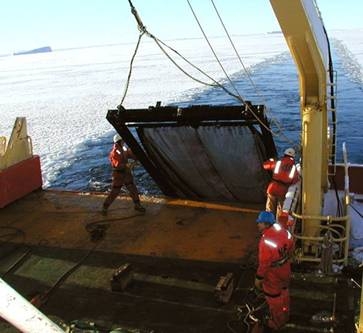
A scientific
net being pulled from an ice-covered sea, using the frame at the stern of
the ship. This net is put into the ocean and then, using an electronic signal,
is opened only when it reaches the depth at which the scientists want to
catch fish. Photo courtesy Jose Torres.
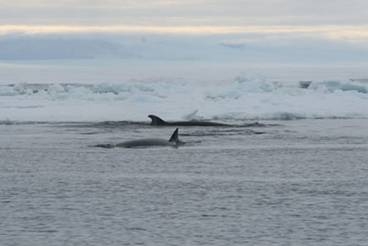
These
are minke whales, the smallest baleen whale (only about 25 feet long!).
Like the Adélie Penguin they occur in pack-ice covered waters, and
they eat the same food as do Adélies, both fish and krill. However,
one whale in a day eats about 2000 times more food than one penguin.

This is not the usual way that
Adelie Penguins eat fish, but this fish was too large to be easily swallowed
while the penguin was swimming. In fact, this penguin had to drag the fish
onto the ice flow, but it could not eat it before a skua swooped down and
swiped it away.
Here’s
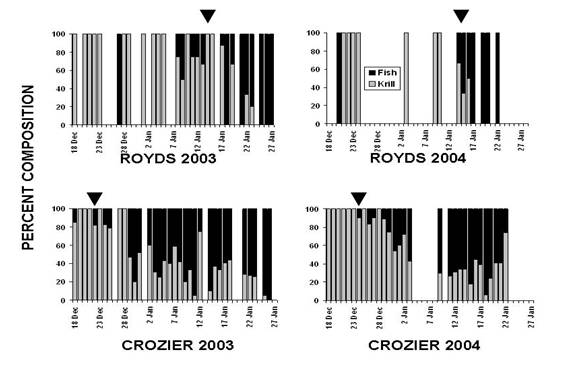
an example of how whales can change what the penguins are eating. In both
years at Royds and Crozier penguin colonies, the penguins’ diet switched
from mostly krill to mostly fish when lots of minke whales appeared in the
penguins’ foraging area. Such a diet switch is ok, as the penguins and
whales have been living together for 3 million years.
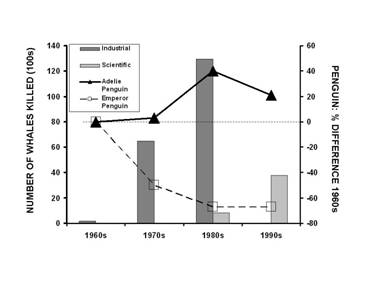
Here
is what happened in the Ross Sea sector when people from Japan killed many
thousands of minke whales during the 1970s and 1980s (see bars, and labeling
on the left). The whales compete with Adelie Penguins for food. As the whale
population decreased the penguin population increased because there was more
food (lines, and labeling on the right). When the whaling stopped, the number
of Adélie
Penguins declined as the whales began to recover and once again were competing
for the food. In the case of Emperor Penguins, whose numbers steadily declined,
we’re not so sure, but maybe the removal of lots of minke whales led
to killer whales eating Emperor Penguins, because no longer were there enough
minke whales to eat. It’s all very complex, but knowing what penguins
eat helps us to understand such things.
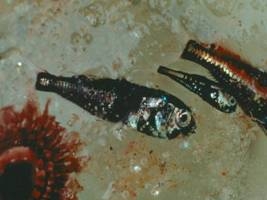
These
are lantern fish, which live in deep water. Adélie Penguins eat
a lot of these during the winter.
Here
a penguin is regurgitating into a bucket. Water was pumped down its throat
until the penguin began to feel so full that it was becoming sick to its stomach.
The penguin was turned over, pointed into the bucket, and out came its food.
The penguin then felt much better. It was released and walked away back to
its nest although, rightly so, it was growling at us as it went.
As a population,
Adélie penguins depend on the ocean to provide large amounts of food.
So far in the history of Adélie Penguins the ocean has been able to
provide enough food to feed the penguins, the whales and the rest of the ocean-going
creatures. Now that man has entered the system, this balance has been interrupted
and Adelie penguins in some areas may have trouble finding enough food to
raise their chicks. In other areas, if whales are killed, they will have an
easier task.
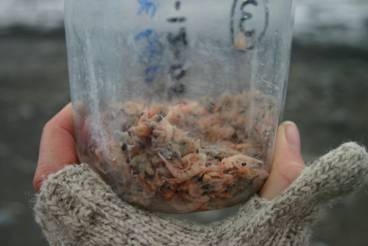
This
is what came out of a penguin, which had just had its stomach pumped. The
pink shrimp are called krill;
the gray stuff is partly digested fish. Fish gets digested much, much faster
than krill, because the krill has a protective shell but the fish does not.
The fish digest right away. We freeze this sample for later analysis. Back
in the laboratory, once this sample is thawed, we have to pick through the
goop to find fish otoliths (ear bones) to identify the fish. We measure
the otoliths and also the krill.

Here
is an Antarctic silverfish. Adélie Penguins eat lots of these during
the summer. It is the most abundant small fish in shallow coastal waters
around Antarctica, and also its shape makes it easy for Adelies to swallow,
head first.
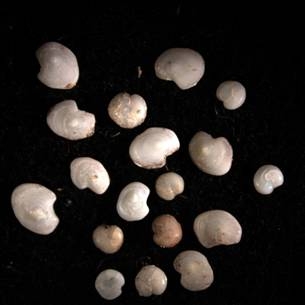
Here
are some fish otoliths, or ear bones, from the two main fish prey of Adélie
Penguins. The small, rounded ones are from silverfish and the larger, flat
ones are from lantern fish. Every fish species has a distinctively-shaped
otolith. Otoliths also grow as the fish grows. Therefore we can tell the
species and the length of the fish that the penguin has eaten. These ear
bones are very small. These have been magnified by about 3 times.
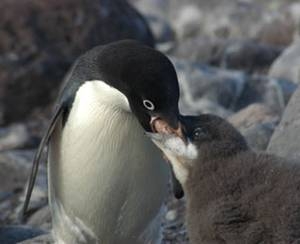
This parent is feeding its chick
some pink stuff, which we know, by its color, is krill. The dark spots in
this pink mass passing from the parent into the chick’s mouth are
the krill’s eyes (which are black).
-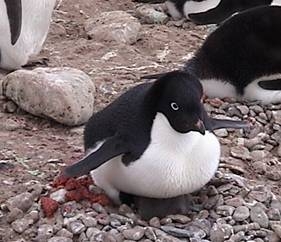
This parent had caught so much
food that it spilled some on the ground while feeding it’s very small
chick (the chick’s mouth was too small!!!). It’s pink, so it’s
krill. Sometimes the parents regurgitate partly digested fish onto the ground.