In
other places of the world many species of birds would co-exist in a small
area. Near my home in California, over a hundred species can be found
within a 50 mile radius. Here at Cape Royds, Ross Island, Antarctica the
conditions are so harsh only four species are commonly seen. When these
sturdy birds adapted to live here they got this place to themselves.
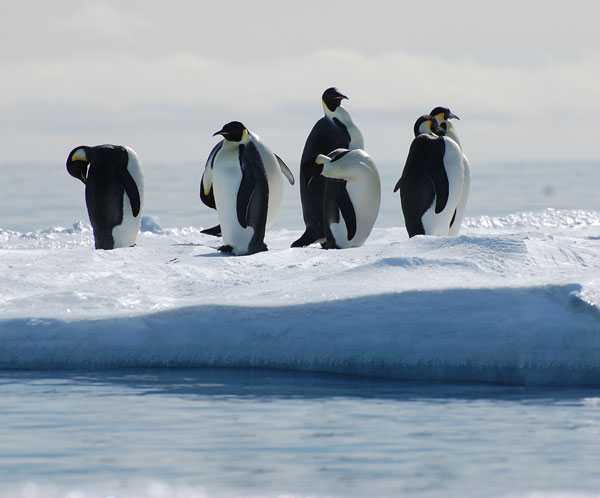 Emperor
penguins are the other true Antarctic penguin species. These gracious
birds and the Adelies never leave the Antarctic and are considered ice
obligates meaning they need ice to live on. At this time they are not
considered an endangered species, but their numbers are declining in some
colonies around the continent as the sea ice conditions change. Adult
Emperors grow to 4 ft and can weigh 50 -100 lbs. To survive the sustained
cold of the Antarctic winters they have a fat layer over an inch thick
and 100 feathers per sq inch. Emperor
penguins are the other true Antarctic penguin species. These gracious
birds and the Adelies never leave the Antarctic and are considered ice
obligates meaning they need ice to live on. At this time they are not
considered an endangered species, but their numbers are declining in some
colonies around the continent as the sea ice conditions change. Adult
Emperors grow to 4 ft and can weigh 50 -100 lbs. To survive the sustained
cold of the Antarctic winters they have a fat layer over an inch thick
and 100 feathers per sq inch.
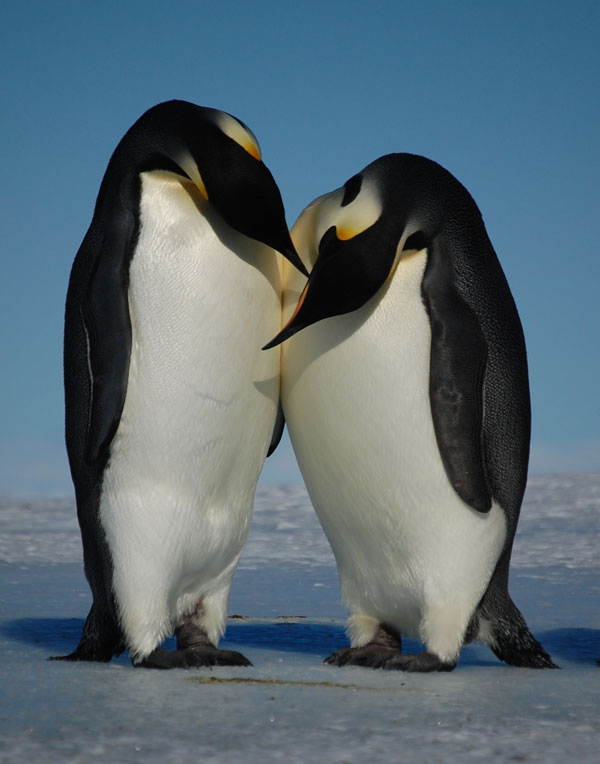 These
birds are actively at sea during the months of January to March eating
krill, small fish and squid as they increase their body stores in preparation
for the breeding season. In late March both male and females will walk
the 30-85 miles to their breeding site where the female will lay a single
1 lb egg, transfer it to the male for incubation and walk back to the
open ocean to feed and replenish her body weight. For the next 65 days
the male will keep the egg warm by holding it on his feet under a large
flap of skin and huddle with the other penguins to ward off the harsh
winds and cold of the Antarctic winter. When the chick hatches in July
the female will be on her way back with food and it will be the males
turn to leave. For the next few months the adults take turns feeding and
guarding the chicks and by December (Antarctic summer) the chicks will
have molted into adult plumage and be ready to feed themselves. By this
time the sea ice will have retreated close to the colony so the chicks
do not have to walk far. These
birds are actively at sea during the months of January to March eating
krill, small fish and squid as they increase their body stores in preparation
for the breeding season. In late March both male and females will walk
the 30-85 miles to their breeding site where the female will lay a single
1 lb egg, transfer it to the male for incubation and walk back to the
open ocean to feed and replenish her body weight. For the next 65 days
the male will keep the egg warm by holding it on his feet under a large
flap of skin and huddle with the other penguins to ward off the harsh
winds and cold of the Antarctic winter. When the chick hatches in July
the female will be on her way back with food and it will be the males
turn to leave. For the next few months the adults take turns feeding and
guarding the chicks and by December (Antarctic summer) the chicks will
have molted into adult plumage and be ready to feed themselves. By this
time the sea ice will have retreated close to the colony so the chicks
do not have to walk far.
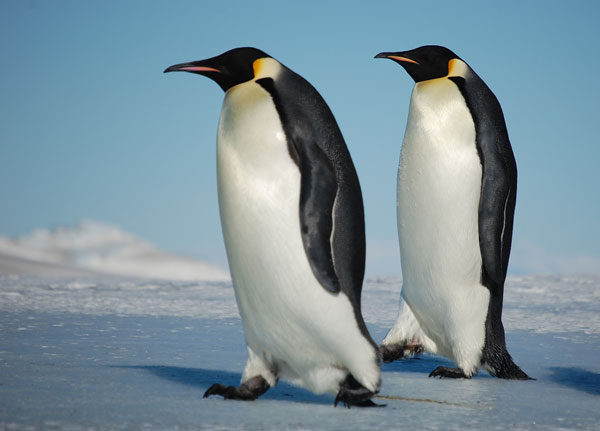
The
Emperors that came to visit Cape Royds this day were non-breeders. These
may be juveniles under the age of 3 who are not ready to breed or other
adults who for some reason did not raise a chick. Open ocean is close
to Cape Royds this year so these large birds feed along the ice edge and
come out onto the ice to rest. They are so much larger than the Adelies
it is easy for us to tell them apart. Slow moving, deliberate and quiet,
these birds walk with purpose and dignity. Although their feet are large
and strong they are not as agile as the Adelie so climbing over ice and
rock is not easy. Today they came onto the land a short way, but quickly
turned around and went back to their home, the ice.
 When
we see these extraordinary creatures there is no need to approach them,
sit down on the ice and their natural curiosity will turn the tables.
We become the object of interest to them and in a few minutes they will
walk over trying to figure out what kind of creatures we are. At first
they are quiet, but then they will start to talk as if they expect me
to respond. I wonder what secrets of the Earth they could tell me if only
I could speak penguin. Similar to my experiences in foreign countries
they will try to speak to me a few times, but finally in disgust at my
lack of response turn their backs and move on. Compared to the Adelies
I have never seen these birds run. A quiet and simple dignity of position
and majesty surrounds their every movement. They are aptly named the Emperor
Penguin. When
we see these extraordinary creatures there is no need to approach them,
sit down on the ice and their natural curiosity will turn the tables.
We become the object of interest to them and in a few minutes they will
walk over trying to figure out what kind of creatures we are. At first
they are quiet, but then they will start to talk as if they expect me
to respond. I wonder what secrets of the Earth they could tell me if only
I could speak penguin. Similar to my experiences in foreign countries
they will try to speak to me a few times, but finally in disgust at my
lack of response turn their backs and move on. Compared to the Adelies
I have never seen these birds run. A quiet and simple dignity of position
and majesty surrounds their every movement. They are aptly named the Emperor
Penguin.
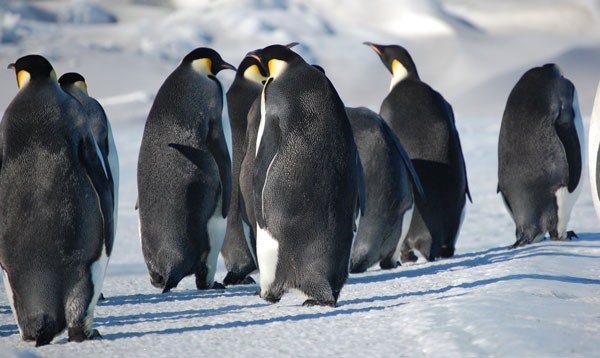 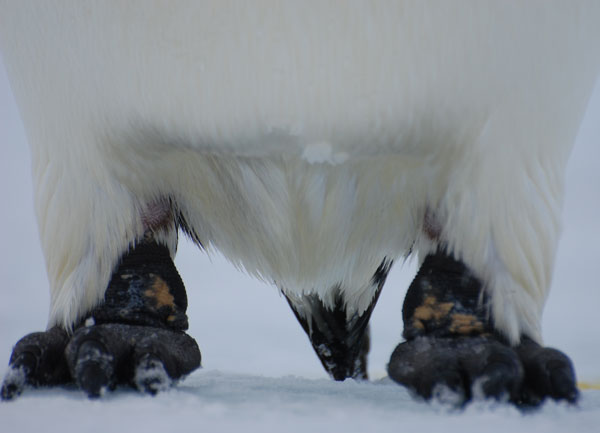
Did
You Know that Emperor Penguins have large strong feet adapted
to walking on ice and holding a single egg for the entire incubation period.
Adelie Penguin feet are also adapted to walking on ice and climbing rocks.
See how these Antarctic birds have adapted to this envrionment here.
Thank
you for following along with the 2009 Adelie Penguin Journal for 2009.
Back
to the Journal
Index page
Learn
more about Adelie penguins at www.penguinscience.com |


 Click image to view a pdf file of this page.