Did You Know ?
1. Adelie
Penguins mate for life or at least try to find the same mate every year.
2. Some Adelie Penguin colonies are increasing in size at a rate that can
not be due to just the number of chicks raised each year.
3. Most Adelie Penguins return to their natal nesting site to raise their
own chicks, but some move away.
4. Adelie Penguins live to be about 15-20 years.
5. Climate change is
causing penguyins to move their colonies.

Banding
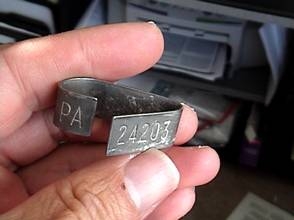
Banding is a very common method for marking birds. In Adelie Penguins, a small metal band is placed around the left wing at the shoulder of the bird. The band has a five digit number etched on it and is readable with field binoculars.

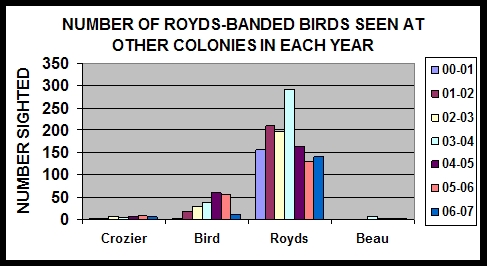
Here are the results of searching for bands at Cape Royds for 7 different years beginning in the summer of 2000-01 (November 2000 to February 2001). You can see that most Royds-banded penguins were seen again at Cape Royds. Some, however, were seen at 3 other colonies, the most being seen at Cape Bird which is the closest other colony to Royds (25 km away).

It is not easy to keep track of penguins with bands. This person is searching through all these penguins looking for banded ones. There are 20 banded penguins somewhere in this picture. We can not walk among the penguins, because that will disturb them; so the person has to remain at the edge of the penguin groups scanning with eyes and binoculars. It takes a lot of walking in a day to search for banded penguins.

In this picture there are three penguins, each with a band on its wing or flipper. These were put on when these penguins were chicks in a previous year. The other 5 penguins in this picture do not have bands. In fact, only a small number of penguins at each colony have a band.


Be a field researcher. Can you count how many penguins there are in this photo? How many are lying on nests? Can you find the three banded penguins? Can you see the yellow nest tag by one of them?
Here is an example of what our banding data has told us. Eight out of every ten (80%) chicks that fledge in any year will not reach the age of 2 years. We search and search and search for banded penguins: walking, walking, and walking. Then we keep very detailed records of what we find each year. We have never seen a penguin that is younger than 2-years-old at a colony. The youngest birds remain at sea. We know how many chicks we band each season, and we know how many of these we see again later in their lives. Most chicks that leave the colony will end up as food for leopard seals and only those who are lucky enough to escape learn to avoid these seals.
This is important information in understanding growths and declines in a population. If 2 out of every 10 (20%) banded chicks return to Cape Royds every year and the same percentage of banded birds disappear from one year to the next, then the population should not be growing. If the population is growing, then other factors must be involved. It is worthy to find out what these other factors might be. In this case, a logical choice would be that birds are emigrating from other colonies. We would know this by banding birds at the other colonies (which we do). Climate change has been forceing penguins to move. We would then wonder why they are moving, which would lead to a bunch of other questions……..
