Adelie
Penguin Adaptations: Wing

 |
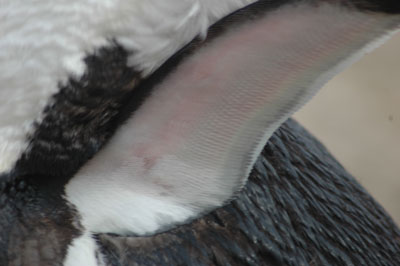 |
| The underside of an Adelie's wing is covered by very small and compact white feathers. When the penguin has not been walking or swimming the color appears white. | This penguin has just come out of the water where it was using its wings to swim. It is, therefore, hot when it emerges onto land. More blood has gone to the skin on the underside of its wings to help to expel this heat and therefore the wing appears pink. Penguins don’t sweat to expel heat. |
 |
 |
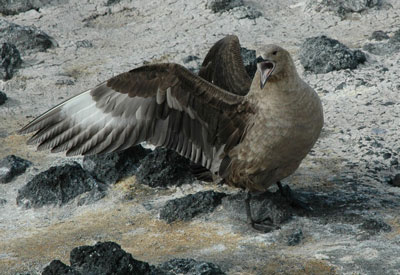
| The ancestors of penguins flew both in the air and in the sea, just like auks (Northern Hemisphere) and shearwaters (Southern Hemisphere) do today. In fact the closest non-penguin ancestor of penguins are the shearwaters, a family of birds that includes the most abundant of all seabirds. Penguins lost their ability to fly in the air when, through evolution, by changing their wings into paddles they became more successful at catching fish.. It is far more strenuous to fly in water than in air, however, so penguins need to have abundant food close by in order to survive. This makes penguins more vulnerable to food shortages than other birds. The above pictures show the difference between a wing meant for flying in the air (skua), and one designed to fly in the water (penguin). | |
| In order to form a paddle-like wing, many of the bones that one finds in the wing of a bird that flies in air, in penguins, have become fused together: several individual bones becoming one bone. The bones have also become flattened. | picture to come |
| In order to flap their wings in the water, penguins have developed HUGE breast and back muscles, making up probably 1/4 of their entire body weight. Unlike birds that fly in the air, which have power only on the down-stroke of the wing, penguins power themselves both on the upstroke and the downstroke. They can swim very fast, probably on the order of about 30-40 km per hour at top speed. | picture to come |
| HOME > TAIL > BEAK > BODY > FEATHERS > FEET > WING > PREENING | |
