Did You Know
?
1. At the capes Royds, Bird and
Crozier colonies, there are about 4 000, 35 000, and 140 000 breeding pairs
of Adélie Penguins; about 40 000 breeding pairs reside at Beaufort
Island.
2. In the entire Antarctic, there are about 2.5 million pairs of penguins
breeding in about 161 colonies, at least as of the mid-1990s.
3. Adélie Penguin colonies are disappearing in parts of
Antarctica but that new colonies are being founded else where? (Click here
to learn more about this recent development due to global climate change.)

How
Many Adélie Penguins
Adélie
Penguins are colonial seabirds. That means they nest close together in colonies,
which range in size from about 10 to 170 000 nests. The colonies are at
least 2 km apart and each is located in an area accessible from the sea
(a beach) and not covered by ice or snow. Within a colony, the nests are
arranged in groups, called sub-colonies. These groups usually are on the
tops of hummocks and not in the valleys between hummocks. This is because
melt water from nearby snow fields and glaciers
runs down the valleys, making the ground too soggy for nest building.
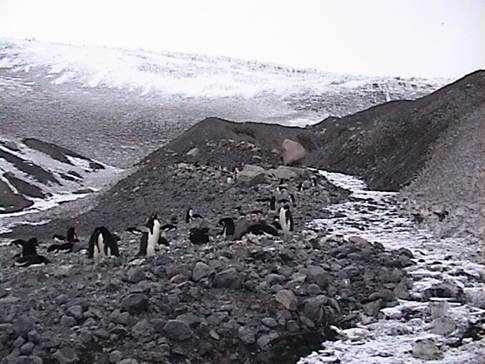
Adélie Penguins nesting
between two roaring torrents coming from a melting glacier.
Considering
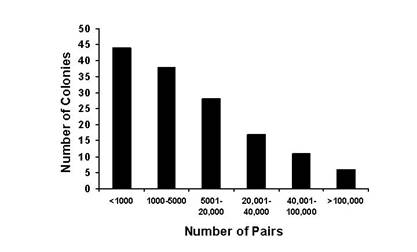
all the 161 colonies of Adélie Penguins in the World and assigning
each to a size category, we see that only 6 colonies are larger than 100 000
pairs. One of our study colonies, Cape Crozier, is one of these. About 1/3
of colonies have fewer than 1000 pairs, and about ¼ have fewer than
5000 pairs, or the size of Cape Royds. Our other study colonies, Cape Bird
and Beaufort Island, are among the larger colonies.
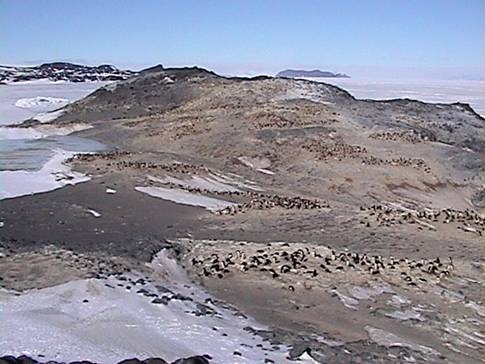
Adélie
Penguins nest in groups, called sub-colonies, that are situated atop ridges
where snow does not form drifts and where melt water does not run in rivers.
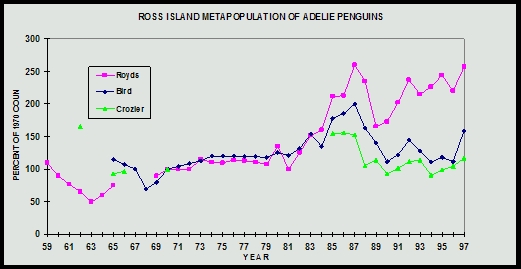
The
numbers of breeding pairs of penguins at our study colonies has been changing
during the past few decades.
We
know the size of the colonies by counting nests with a penguin on it. We also
keep records of banded birds, knowing
how many each season find a mate and lay eggs. These are the breeding penguins.
Those that have a nest but with no eggs are called non-breeders. Many non-breeders
make a nest and search for a mate to then breed the following year. For every
two breeding penguins there is one non-breeder that is present at the colony
during the summer (we know this from banding). There are also other penguins
who never visit the colony, until they are at least 2-3 years old. By knowing
the ratio of breeding to non-breeding penguins, we can estimate the breeding
population of a colony.
It
would be impossible to determine the number of nesting pairs in the mass
of penguins at Beaufort Island in the photo on the left. This image was
taken in late January, when not only are there adult penguins but also large
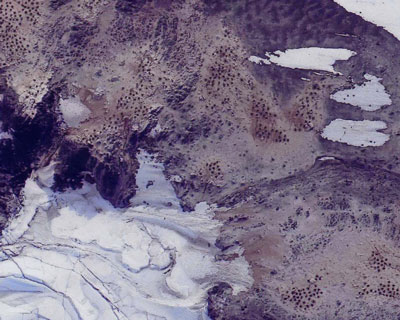
chicks. In order to accurately determine the number of nesting pairs in
a large penguin colony, it is necessary to use aerial photos taken on or
about December 1, photo on right, when A) only one member of each pair is
sitting on the eggs, while the other is off at sea feeding; and B) there
are very few non-breeders present. This means that almost all nests with
a penguin on it has eggs. Flying at 2000 feet, so as not to disturb the
penguins, a series of photos can be taken and then the dots counted. In
the picture on the right almost every dot represents a penguin sitting on
its nest. Counts by people on the ground at the same time can determine
the proportion of nests where there is a non-breeder --- there are usually
only a few when aerial photos are taken.

It
is important to have accurate population counts of Adélie Penguins
as well as other birds and animals in our world so we know if their populations
are increasing or decreasing. As our Earth changes due to climate warming,
habitat destruction and human use of resourses the other species we share
this planet with must cope. Some species have had to move their homes and
change their food sources, others have declined in numbers, and some have
not been able to cope and have become extinct, no longer part of our world.
Keeping track of Adélie Penguin populations helps us monitor how they
are coping with changes in their habitat.To read more about changes in Adélie
Penguins habitat click here.
Daily
counts of penguins in one sub-colony --- well, except when the weather is
bad --- reveal how the number of penguins in a colony changes over time in
a spring-summer season. Note that when the aerial photo was taken of this
colony, Cape Royds (see photo above), the number of nests with eggs had not
changed between Nov 25 and Dec 5, and that the number of penguins just about
equaled the number of nests with eggs. After this period the number of nests
with eggs slowly decreased, as eggs were lost to skuas. Therefore, the aerial
photo taken on Dec 1 showed just the breeding population at its maximum.